
Most homeowners do not think about their roof until it fails. A ceiling stain appears. Water drips during a storm. An insurance adjuster says the shingles are at end of life. At that point, the decision-making pressure is high and the information available is low.
This guide is designed to fix that. It covers how to read your roof's condition before failure occurs, which symptoms are urgent versus monitorable, what NJ roof repairs actually cost in 2025, how to decide between repair and replacement, what roofing materials perform best in NJ's specific climate, and what maintenance tasks prevent the most expensive failure modes. The NJ-specific context throughout reflects the climate, permit environment, and housing stock that distinguishes this market from national averages.
A roof communicates its condition through observable signals, most of which are readable from ground level or from inside the attic without climbing on the roof. Knowing how to read them — and which ones require immediate action versus ongoing monitoring — is the most practical skill a NJ homeowner can have.
The attic reveals what the exterior cannot. Before calling a roofer, a five-minute attic inspection with a flashlight gives you critical diagnostic information. What to look for:
Water staining on decking or rafters. Dark staining below a specific penetration (chimney, pipe, skylight) indicates that penetration is leaking. Staining spread across a wider band near the eaves typically indicates ice dam water intrusion. Staining in the middle of a field of decking with no penetration overhead suggests a shingle lap failure or open nail head.
Daylight through the deck. Any visible light through the roof decking means there is an opening. This is urgent regardless of whether an active leak has been noticed yet.
Frost or moisture on the underside of the deck. Visible in winter, this indicates the attic air is too warm and humid — a ventilation problem that will produce condensation, accelerate shingle degradation from below, and create ice dam conditions at the eaves.
Insulation pushed toward the eaves. Blocking soffit intake vents, which restricts cold air flow into the attic and creates the thermal conditions that cause ice dams.
Walking on an asphalt shingle roof causes granule loss and can crack shingles, especially in cold weather when shingles are brittle. A ground-level inspection with binoculars plus an attic inspection covers 90 percent of what a professional inspection uncovers. NJ Roofing provides free written inspections with photographs for anything that requires actual roof access.
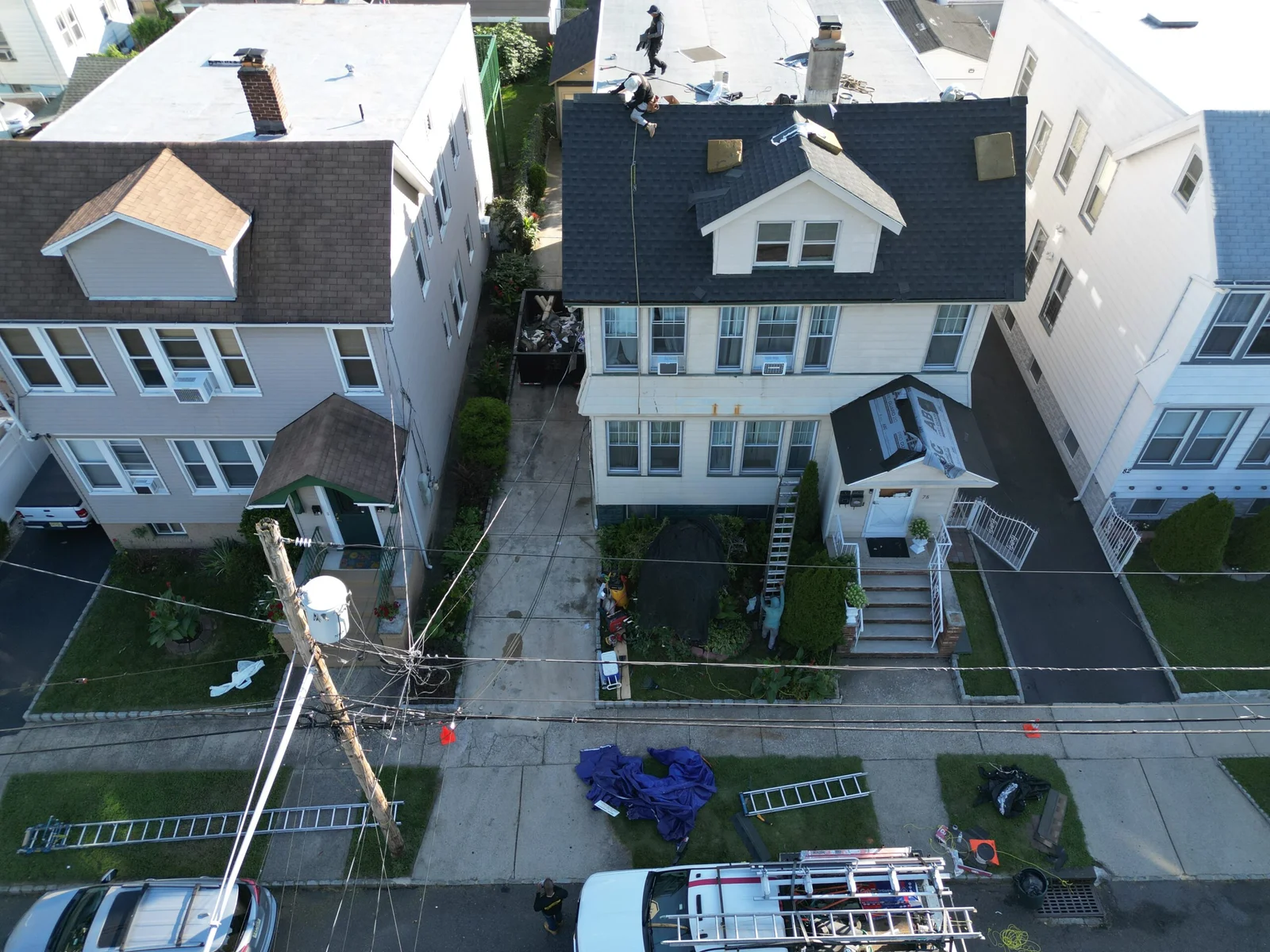
NJ roof repair costs are higher than national averages published on most consumer websites, for the same structural reasons that make full NJ replacement more expensive: labor rates, insurance overhead, disposal costs, and permit requirements all run above the national norm. The table below reflects actual 2025 NJ repair pricing from NJ Roofing project data across Essex, Bergen, Union, Hudson, and Morris counties.
| Repair Type | NJ Cost Range 2025 | DIY / Pro | Notes |
|---|---|---|---|
| Shingle replacement (1–10 shingles) | $250–$550 | Pro only | Improper installation voids manufacturer warranty; color match matters for resale |
| Pipe boot / vent flashing replacement | $180–$400 | Pro only | Most common single-point leak source on NJ homes; 5–15 yr lifespan on rubber boots |
| Valley flashing repair | $400–$900 | Pro only | Open-cut vs. woven valley; NJ's heavy rain loading makes this a high-consequence repair |
| Chimney flashing (step + counter) | $600–$1,800 | Pro only | Most complex residential flashing; freeze-thaw cycling is the primary failure mechanism |
| Skylight resealing or flashing repair | $350–$950 | Pro only | Distinguish between flashing failure (repairable) and lens seal failure (skylight replacement) |
| Ridge cap replacement (full ridge) | $550–$1,200 | Pro only | Wind is the primary cause; after major nor'easters this is a common NJ emergency repair |
| Soffit and fascia repair (per section) | $300–$700 | Pro only | Often caused by gutter overflow; fix gutters first or the fascia fails again |
| Gutter repair or reseating | $150–$450 | DIY possible | Bracket reattachment and seam resealing are DIY-capable; full replacement requires pro |
| Emergency tarp (storm damage) | $350–$800 | Pro only | Temporary protection; documents damage for insurance; NJ Roofing responds 24/7 |
| Deck repair (per sheet of OSB) | $90–$175 | Pro only | Found during tear-off on most replacements; also occurs as isolated repair on active leaks |
The most expensive repair pattern is addressing the same area repeatedly on an aging roof. A $350 pipe boot repair on a 24-year-old roof with widespread granule loss is not a $350 fix — it is the first of several repairs that will collectively approach replacement cost over the next two to three years, while the underlying system continues deteriorating. If you have had two or more repairs on the same roof section within 36 months, ask NJ Roofing to assess whether repair or replacement is the better economic decision.
The repair vs. replacement decision is the question NJ homeowners most often get wrong, usually in one of two directions: replacing a roof that had years of serviceable life remaining, or repairing a roof that was past the point where repair adds value. The decision framework below works through the four variables that actually determine the right answer.
NJ Roofing provides a written inspection report and honest recommendation on this question for every property we assess. We do not automatically recommend replacement — a roof with five to eight years of remaining serviceable life should be repaired, not replaced. And we do not recommend repairs on a system that is clearly past the point where repair adds value.
If roof damage was caused by a covered peril — storm, hail, wind, fallen tree — your homeowner's insurance may cover the replacement cost less your deductible regardless of age, under an Actual Cash Value (ACV) or Replacement Cost Value (RCV) policy. Before deciding between repair and replacement on an older damaged roof, confirm your coverage type. NJ Roofing can document storm-specific damage for an insurance submission. Call 201-218-3666 for storm damage assessment.
Material selection for a NJ roof replacement involves constraints that do not apply in most other states. NJ's freeze-thaw cycling, nor'easter wind loading, UV exposure, and biological growth pressure (from tree canopy and humidity) create a specific performance profile that the right material needs to meet. The options below cover the practical range for NJ residential properties.
Wood shake is not viable in most NJ municipalities due to fire code. Clay tile and concrete tile require structural load assessment that most NJ homes built before 1980 cannot accommodate without reinforcement. These are not niche constraints — they affect a significant percentage of the materials that appear on national "best roofing materials" lists. In practice, premium architectural asphalt, metal, and slate cover the real decision space for most NJ homeowners.
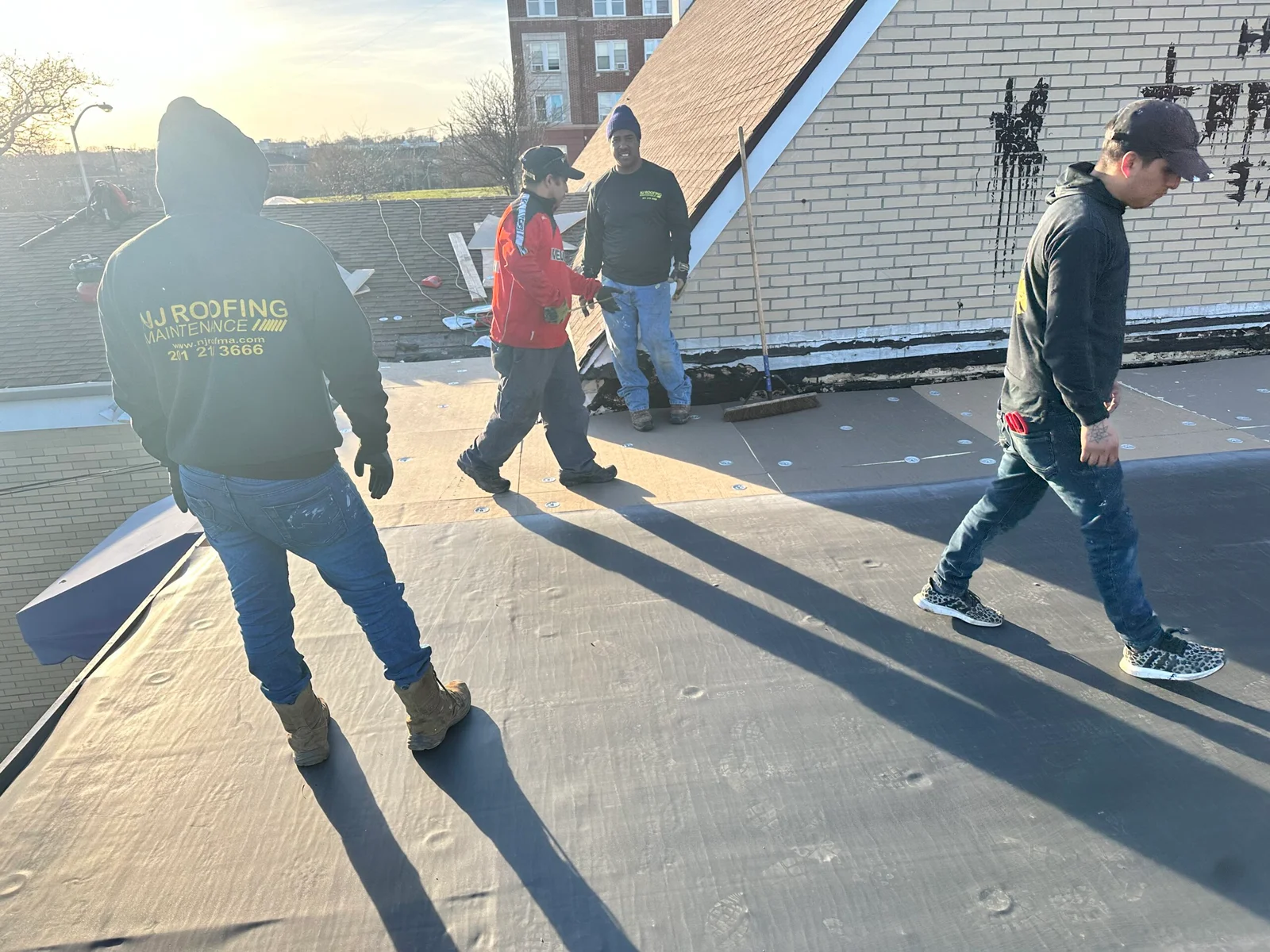
Not all maintenance tasks return equal value. The five tasks below account for the large majority of preventable roof failures on NJ residential properties. Doing these consistently is worth more than any other investment in roof longevity.
Clogged gutters are the single most common cause of preventable roof damage in NJ. They cause fascia rot, soffit damage, ice dams at the eaves, and foundation water intrusion — and most of it is invisible until it has already progressed. The critical timing is: spring cleaning after the last tree debris has settled (typically April), and fall cleaning after all leaves have dropped but before the first hard freeze (typically mid-to-late November in northern NJ). A gutter full of wet leaves that freezes solid cannot drain and will either pull away from the fascia or back water under the eaves. See our gutter cleaning service for NJ scheduling.
A ground-level visual inspection by a homeowner catches obvious failures. A professional inspection with roof access catches developing failures — sealant fatigue at penetrations, early flashing separation, first-season granule loss patterns — before they become active leaks. NJ Roofing provides free written inspections for any property owner in our service area. On roofs over 15 years old, an annual inspection is the highest-return maintenance investment available. Our maintenance plan includes annual professional inspection starting at $25.99/month.
Inadequate attic ventilation is the root cause of most ice dam events in NJ. The mechanism: heat escaping through an under-insulated or poorly ventilated roof deck warms the snow above it. That snow melts and runs to the cold eave, where it refreezes into an ice dam. The dam backs water up under shingles and into the ceiling below. The permanent fix is not heating cables — it is bringing attic insulation to NJ Energy Code minimum (R-49 to R-60) and ensuring soffit intake vents are not blocked by insulation displaced toward the eaves. NJ Roofing assesses ventilation as part of every inspection.
Every pipe boot, chimney base sealant joint, skylight perimeter, and roof-to-wall transition has a sealant component with a finite lifespan. In NJ's freeze-thaw climate, sealant at these points typically degrades in eight to twelve years, sometimes faster on south-facing high-UV exposure slopes. Catching and resealing a joint before it opens fully is a $150 to $300 repair. Missing it until it has allowed water penetration for two winters is a $1,500 to $6,000 remediation. Annual inspection specifically checking sealant condition at all penetrations is how you stay on the right side of that cost difference.
Algae (the black streaking visible on most NJ roofs facing north or under tree canopy) is primarily cosmetic in early stages but indicates a moisture-retaining roof surface. Moss is more actively damaging: its root structures lift granules and hold moisture against the shingle face. Lichen is the most destructive: its chemical adhesion to granule material is strong enough that removal causes additional granule loss. Treatment with diluted zinc sulfate or oxygen bleach applied with a low-pressure sprayer — never a pressure washer, which removes granules directly — addresses early-stage growth. Zinc or copper strips installed at the ridge create runoff that prevents regrowth. Address this before lichen establishes; once established, it cannot be removed without damaging the shingles beneath it.
Free written inspection, same-day report with photos. Maintenance plans from $25.99/mo include inspection, minor repairs, and gutter cleaning. Licensed #13VH09260500. Serving all of NJ since 2016.
Hiring the wrong roofing contractor is one of the most expensive home-improvement mistakes available. The NJ market has a meaningful number of contractors operating without proper licensing or insurance, and the consequences of a bad installation can persist for the entire remaining life of the roof. The checklist below covers what every NJ homeowner should verify before signing any roofing contract.
For a more detailed treatment of contractor red flags specific to the NJ market, see our article on why roofers have a bad reputation and how to hire around it.
Free written inspection, honest repair vs. replacement assessment, itemized written estimates. Licensed #13VH09260500. $2M+ insured. GAF Master Elite certified. 24/7 emergency response. Serving NJ since 2016.
