
New Jersey puts roofs through more weather stress than homeowners in most states deal with. The same roof absorbs summer heat above 95°F, endures nor'easters with sustained winds above 60 mph, cycles through freeze-thaw dozens of times each winter, and sheds heavy wet snow loads that can approach 40 pounds per square foot. That combination does not just happen to roofs passively — it accelerates degradation at specific points, in specific sequences, that predictable maintenance can address before they become expensive failures.
This guide replaces the generic "inspect your roof twice a year" advice with a specific, NJ-calibrated maintenance schedule. Each season has distinct tasks tied to what the NJ climate is actually doing to your roof during those months. The cost-of-neglect table shows what deferred maintenance typically costs compared to the preventive alternative. And the sections on what a homeowner can do themselves versus what requires a licensed contractor give you a realistic picture of where professional involvement pays for itself.
"Most premature roof failures in NJ are not material failures. They are maintenance failures. A roof that could have lasted 28 years routinely ends at 18 because gutters backed up, flashing was never resealed, and a small leak was ignored for two seasons."
Generic roofing maintenance advice is written for a generic climate that does not describe New Jersey. NJ sits in USDA hardiness zones 6a through 7b, which means the full continental temperature swing: cold enough winters for significant freeze-thaw cycling, hot enough summers for UV-driven shingle degradation, and enough precipitation year-round to keep moisture pressure constant on every roofing system component.
The specific stresses NJ roofs experience, and when they peak, are:
The four seasonal sections below are interactive — click any season to expand the specific maintenance tasks for that period. Each task is marked with a priority level and a note on whether it is a DIY task or requires professional involvement.
Spring is the most important maintenance window for NJ roofs. Everything winter did to your roof — freeze-thaw damage, ice dam effects, wind-lifted flashing, compressed soffit vents under snow — becomes visible in March and April. Addressing it now prevents active leaks from developing through the spring rain season.
From ground level, scan all slopes for missing or displaced shingles, granule loss, curling or cupping at shingle edges, and any visible uplift at ridgeline or valleys. Use binoculars for detail. Any shingle damage found now should be repaired before April rain. Professional inspection recommended if the roof is over 15 years old or if winter included any significant ice dam activity.
Remove all debris accumulated since fall. Run water from a garden hose at the top of each gutter run and watch for proper flow to the downspout, no standing water in the gutter trough, and no dripping at seams or end caps. Check downspout extensions are directing water at least four feet from the foundation. DIY if comfortable on a ladder; professional service available from NJ Roofing.
Check the sealant condition at every roof penetration: chimney base and counter-flashing, pipe boots, skylight perimeter, and any roof-to-wall transitions. Freeze-thaw cycling specifically attacks these points. Sealant that has cracked, separated, or been displaced by frost heave should be reapplied before the spring rain season. Professional service recommended for chimney step flashing or anywhere the penetration is on a steep slope.
With a flashlight, inspect attic decking and rafters for any new water staining, frost marks, or mold that appeared over winter. Staining on the decking directly below a penetration indicates flashing failure. Staining spread across a wider area near the eaves indicates ice dam water intrusion. DIY inspection; professional assessment if staining is found.
Confirm that soffit vents have not been blocked by insulation pushed toward the eaves over winter or by nesting activity. Blocked soffit vents restrict intake airflow and set up ice dam conditions for the following winter. Ridge vent should be clear of debris and properly seated. DIY visual check; professional if vents need clearing or repair.
Any branches that came within striking distance of the roof during winter winds should be trimmed before summer growth adds more weight and reach. On NJ properties with significant tree canopy (especially in South Orange, Glen Ridge, Maplewood, Montclair, and West Orange), this is an annual spring task. DIY with appropriate tools or arborist for large limbs.
Summer is the lowest-urgency maintenance window for NJ roofs, but it is the right time for longer-horizon observations: tracking granule accumulation in gutters as an indicator of shingle age, monitoring attic temperature as an indicator of ventilation adequacy, and addressing biological growth before it becomes established enough to damage shingle surfaces.
A properly ventilated NJ attic should stay within 10–15°F of the outdoor air temperature. An attic reaching 130–150°F on a hot July day is a sign of inadequate ventilation. That heat is baking your shingles from below and shortening their lifespan by years. If you have a thermometer, check the attic on the hottest afternoon of the year. Anything above 120°F warrants a ventilation assessment. DIY check; professional for ventilation improvements.
After the first summer rain, check gutter downspout screens and the bottom of gutter troughs for granule accumulation. Some granule loss is normal. A heavy accumulation of granule material — enough to fill a hand — after a moderate rain indicates accelerated aging. This is the most reliable indicator of where shingle life is being lost and how much remains. DIY observation; professional assessment if granule loss is heavy.
Black streaks on NJ roofs are Gloeocapsa magma algae. Green patches are moss. Both are addressed with a diluted zinc sulfate or oxygen bleach solution applied from ground level with a garden sprayer — never pressure wash an asphalt shingle roof, as it removes granules. For moss, zinc or copper strips installed at the ridge produce runoff that prevents regrowth. DIY treatment for mild cases; professional for established growth or high-pitch roofs.
Seed pods, helicopter seeds from maples, and summer debris can block gutters on NJ properties with tree canopy. A quick visual check and flush in July prevents overflow during August thunderstorm season. DIY.
Fall is the second most important maintenance window. The preparation work done between September and late November determines how the roof performs during the winter's freeze-thaw cycles, ice dam conditions, and snow loading. The specific window matters: gutter cleaning after the leaves fall but before the first freeze is the critical task sequence.
This is the single most impactful maintenance task for NJ residential roofs. Gutters must be cleaned after all leaves have fallen (typically late November in northern NJ, mid-November in central and southern NJ) and before the first hard freeze. A gutter full of wet leaves that freezes solid cannot drain and will either pull away from the fascia under ice weight or back up water under the shingles at the eave. Professional service available from NJ Roofing. Schedule early — this is our busiest window.
If you experienced ice dams last winter, fall is the time to address the root cause before the next one. The root cause is almost always one of three things: inadequate attic insulation allowing heat to escape through the roof deck and melt snow; blocked soffit vents restricting cold air intake to the attic; or inadequate ice and water shield coverage at the eaves (required in NJ to extend 24 inches inside the exterior wall line). Professional assessment required to correctly identify and address ice dam conditions.
Any shingle damage, unsealed flashing, or open penetration found now should be repaired before winter. A small entry point for water is minor in September. After a freeze-thaw cycle works it open and a February ice dam forces water through it, it becomes a ceiling damage event. Professional inspection recommended if the roof is over 10 years old.
The chimney crown (the concrete cap at the top) and the chimney cap (the metal cover) take the full force of NJ winter. Cracks in the crown allow water to freeze and expand, accelerating deterioration rapidly. A missing or damaged chimney cap allows rain and wildlife access to the flue. Both should be addressed before winter. Professional service; requires ladder and chimney access.
NJ Energy Code recommends R-49 to R-60 attic insulation for most residential applications. Below R-30, heat loss through the roof deck is significant enough to create ice dam conditions in a typical NJ winter. If you do not know your attic's current R-value, fall is the time to check. Adding blown-in insulation before winter is one of the highest-return maintenance investments available. Professional installation for blown-in insulation.
Active winter maintenance is more limited than other seasons — most of the preparation work is done in fall. The winter tasks are primarily reactive: managing snow accumulation on roofs that are structurally borderline, responding correctly to active ice dams, and knowing when to call for emergency service.
Most NJ residential roofs are designed for the local ground snow load (20–30 psf in most of NJ). A standard sloped roof on a properly built home can handle NJ snow loads. The risk situations are: flat or low-slope roofs that accumulate wet snow without shedding; roofs with existing structural issues; and heavy wet snow events above 12 inches. Use a roof rake from ground level for accessible areas — never walk on a snow-covered roof. Emergency removal available from NJ Roofing 24/7.
If icicles are forming at the eaves and there is water staining or active dripping inside the house, the ice dam is already backing water up. Do not attempt to chip ice off a roof. The correct emergency response is: place buckets for active drips; apply calcium chloride (not rock salt, which damages shingles) in a pantyhose sleeve along the ice dam to create a drainage channel; and call NJ Roofing for professional ice dam assessment and emergency tarp if needed. Call 201-218-3666 for 24/7 emergency response.
After major nor'easters, walk the perimeter of the house from ground level and look for: displaced or missing shingles visible against the snow; displaced ridge cap material; any debris on the roof from nearby trees; and water staining on exterior walls below gutters indicating overflow. Document with photos for insurance purposes. DIY from ground level only; never inspect an icy roof.
Downspouts can freeze solid during extended cold snaps, preventing drainage when ice dams melt. If you see water pouring over a gutter during a thaw period, the downspout is likely frozen. Wrap the downspout with heat tape or pour hot water at the base to clear it. DIY.
The argument for consistent roof maintenance is straightforward when put in financial terms. The table below compares the typical cost of the preventive action against the typical cost of the failure it prevents, based on NJ pricing and NJ Roofing project data.
| Issue | Preventive Action & Cost | If Ignored — Typical NJ Repair Cost |
|---|---|---|
| Failed pipe boot or flashing sealant | Reseal or replace boot: $150–$400 | Decking rot + drywall repair + mold remediation: $1,500–$6,000 |
| Clogged gutters | Annual cleaning: $150–$350 | Fascia board replacement + foundation grading + ice dam damage: $1,200–$5,000 |
| Ice dam (addressable ventilation issue) | Attic insulation upgrade: $1,500–$3,500 | Ice dam water damage to ceiling, walls, insulation — recurring annually: $2,500–$10,000/yr |
| Cracked chimney crown | Crown repair or resurfacing: $300–$800 | Full chimney rebuild from freeze-thaw deterioration: $4,000–$18,000 |
| Moss/lichen on shingles | Treatment and zinc strips: $200–$500 | Premature shingle replacement 5–8 years early: $10,000–$22,000 |
| Single missing shingle | Shingle replacement: $150–$300 | Decking damage + multiple shingle replacement after one winter: $800–$3,000 |
NJ Roofing's maintenance plans start at $25.99/month ($311.88/year). A single avoided pipe boot failure, gutter overflow event, or ice dam season pays for several years of that plan. The plan includes annual professional inspection, minor repairs, and gutter cleaning — the three tasks that prevent the most costly failure modes on NJ residential roofs.
Not every maintenance task requires professional involvement. Being clear about the distinction saves money on the tasks that do not need a contractor and prevents the injuries and warranty-voiding mistakes that come from attempting tasks that do.
Pressure washing is the most common DIY maintenance mistake NJ homeowners make. The granule coating on asphalt shingles is what protects them from UV degradation and provides fire resistance. A single pressure washing session can remove years of that protection. For algae and moss: diluted oxygen bleach or zinc sulfate applied with a low-pressure garden sprayer, rinsed with a garden hose — never a pressure washer.
NJ's housing diversity means maintenance priorities are not uniform across the state. The home type you have affects which tasks matter most and which failure modes are most likely.
Steep-pitch roofs with dormers, multiple valleys, and complex flashing at every penetration. The high tree canopy in these neighborhoods means gutter cleaning is critical twice yearly — spring and post-leaf-fall. Flashing at dormer bases and where two roof planes intersect is the most common failure point. These homes often have narrow valleys that accumulate debris faster than open-gable roofs. Professional inspection is particularly valuable on homes built before 1950 where original flashing may still be in service.
Simpler rooflines mean fewer flashing complexity points, but these homes are now entering or past typical shingle replacement age (25–30 years for original installations from the 1960s–1990s). The most important maintenance task is granule accumulation monitoring — heavy granule loss in gutters is the primary indicator that these homes need replacement planning. Attic ventilation on cape cod-style homes is particularly important, as the half-story creates ventilation dead zones that accelerate shingle wear.
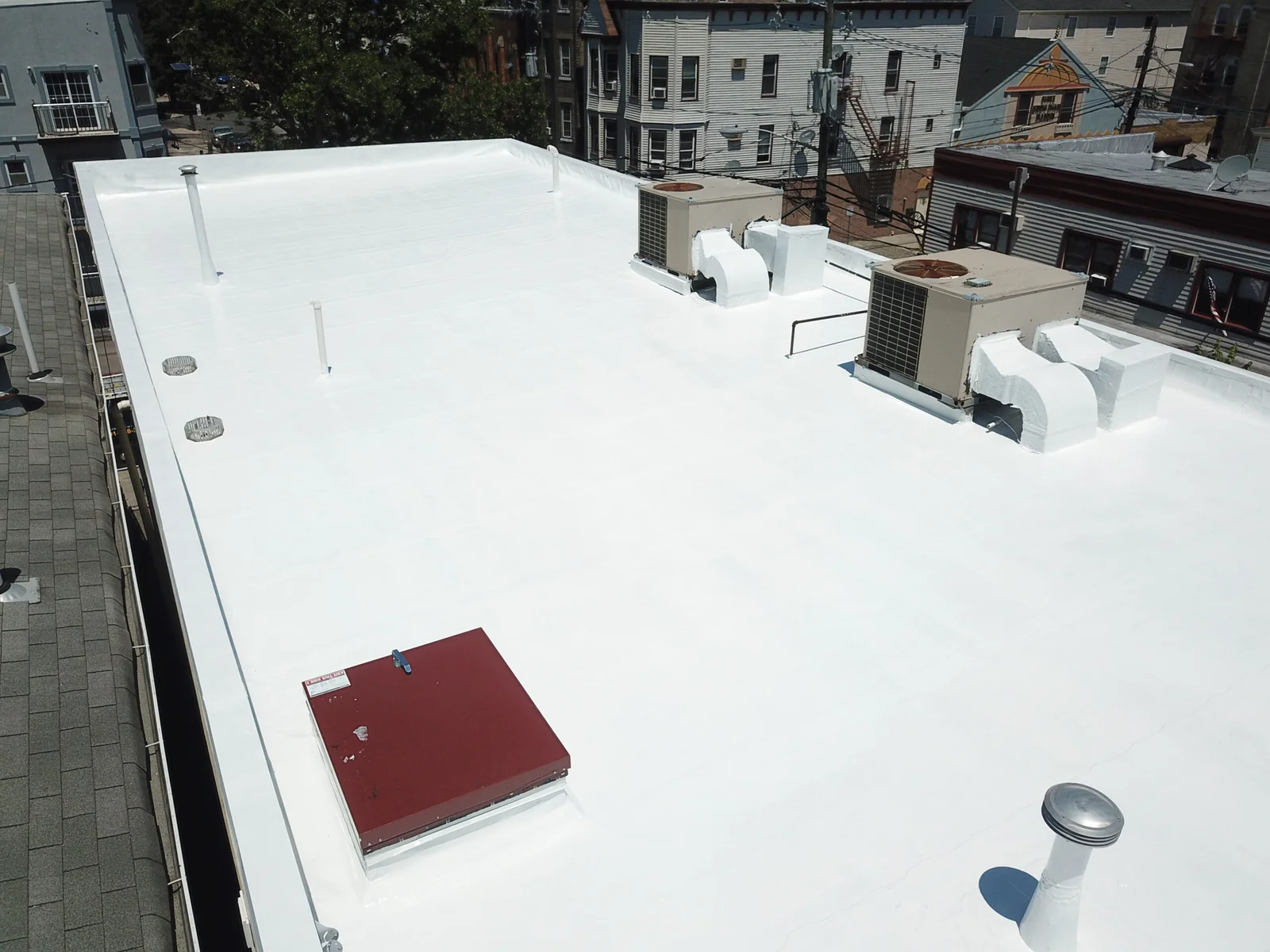
Flat EPDM or TPO roofs have different maintenance priorities than residential shingle systems. The key tasks are annual seam and flashing inspection (performed by a licensed contractor with knowledge of the specific membrane system), drain clearing to prevent ponding water, and HVAC curb flashing inspection after any rooftop mechanical servicing. Ponding water is the primary failure accelerator on NJ commercial flat roofs — any area that holds water for more than 48 hours after rain needs drainage correction. See our commercial roof inspection page for flat roof-specific maintenance guidance.
Maintenance plans from $25.99/mo include annual professional inspection, minor repairs, and gutter cleaning. No scheduling friction, no deferred inspection, no missed maintenance windows. Licensed #13VH09260500. Serving all of NJ since 2016.
NJ Roofing provides maintenance plans, annual inspections, gutter cleaning, and emergency repair throughout New Jersey. Licensed #13VH09260500. $2M+ insured. Serving NJ since 2016.
