
Flat roof replacement in New Jersey is one of the more misunderstood roofing purchases a property owner makes. The per-square-foot figures that appear on national roofing websites significantly understate actual NJ costs, the three main membrane options (EPDM, TPO, and modified bitumen) are frequently confused with each other, and the variables that drive cost on a flat commercial or residential roof are different from those that drive cost on a pitched shingle roof.
This guide covers actual 2025 NJ pricing for flat roof replacement across all three membrane systems, the cost drivers that matter most in this market, what the per-square-foot number actually includes in a legitimate NJ quote, and how to compare proposals from multiple contractors. NJ Roofing installs EPDM, TPO, and modified bitumen systems throughout Essex, Bergen, Union, Hudson, and Morris counties, and the numbers here reflect actual project costs, not national averages.
"The most expensive flat roof replacement in NJ is the cheap one that fails in four years. The most cost-effective investment is the correctly specified system from a licensed contractor with a manufacturer warranty behind it."
Most NJ flat roof replacements use one of three membrane systems. They are not interchangeable — each has a different cost profile, performance characteristic, and ideal application. Understanding the differences is the foundation for evaluating any proposal you receive.
EPDM is the default for most NJ residential flat sections and smaller commercial buildings. TPO is the right choice when energy efficiency is a priority or when NJ energy code compliance is required. Modified bitumen is most often used on older commercial buildings where existing layers are being supplemented rather than fully replaced, or where the building's mechanical systems make single-ply installation impractical. NJ Roofing can advise on the best system for your specific property during a free inspection.
The total project cost depends heavily on roof size, which varies enormously by property type. The table below shows typical total replacement costs for NJ properties in 2025, using mid-range EPDM or TPO pricing and assuming standard access and a single-layer tear-off.
| Property Type | Typical Roof Size | EPDM Total | TPO Total | Mod Bit Total |
|---|---|---|---|---|
| Residential flat section (addition, porch, garage) | 200–600 sq ft | $1,800–$6,000 | $2,000–$7,000 | $2,200–$7,500 |
| Townhouse or row home (full flat roof) | 800–1,500 sq ft | $6,500–$16,000 | $7,500–$18,000 | $8,000–$19,000 |
| Small commercial / retail | 1,500–4,000 sq ft | $12,000–$42,000 | $14,000–$46,000 | $15,000–$50,000 |
| Mid-size commercial / warehouse | 4,000–10,000 sq ft | $32,000–$95,000 | $36,000–$105,000 | $38,000–$115,000 |
| Apartment building (NJ mid-rise) | 5,000–20,000 sq ft | $40,000–$180,000 | $45,000–$200,000 | $48,000–$210,000 |
These ranges assume single-layer tear-off, standard HVAC penetration flashing, and normal roof access. Projects with multiple existing membrane layers, heavy HVAC equipment requiring work-around installation, parapet wall flashing, or limited crane/equipment access will run toward or above the high end of each range.
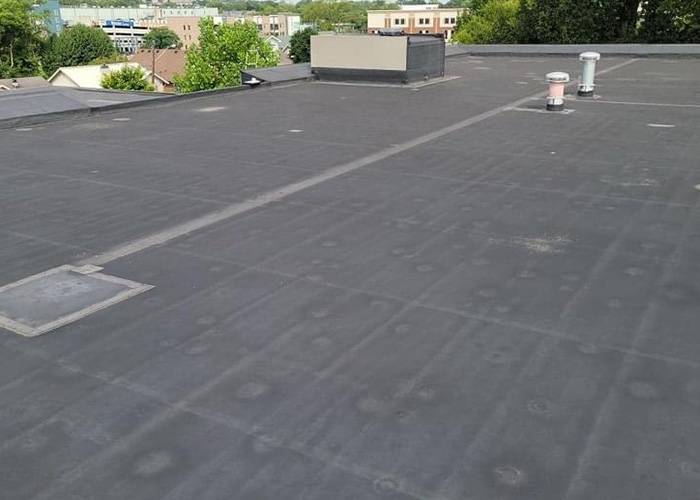
The per-square-foot figure in a flat roof quote is only meaningful if you know what it includes. A legitimate NJ flat roofing estimate should break out the following line items clearly. If a contractor provides only a lump sum without this detail, you are not in a position to compare their quote to any other.
| Cost Component | What It Covers | Typical NJ Range |
|---|---|---|
| Membrane material | EPDM, TPO, or mod bit sheet at specified mil thickness and brand | $1.80–$4.50/sq ft |
| Insulation (if included) | Polyiso or tapered insulation board beneath the membrane | $2.00–$5.00/sq ft |
| Adhesive / fasteners | Bonding adhesive for fully adhered; screws and plates for mechanically fastened | $0.60–$1.50/sq ft |
| Seam tape and primer | Seam sealing; critical for waterproofing at membrane joints | $0.40–$1.00/sq ft |
| Flashing (perimeter & penetrations) | Parapet cap, HVAC curb flashing, pipe boots, drain assemblies | $3.00–$8.00/linear ft |
| Tear-off and disposal | Removal of existing membrane(s), disposal at licensed NJ facility | $1.00–$2.50/sq ft |
| Deck repair (if needed) | Replacement of compromised substrate decking found during tear-off | $75–$150/sheet |
| Labor | Licensed NJ crew; fully adhered installs take longer than mechanically fastened | $3.50–$7.00/sq ft |
| NJ permit | Required in most NJ municipalities for commercial re-roofing; varies by town | $200–$1,500+ |
Two flat roofs that are the same square footage can have meaningfully different project costs. The eight factors below account for most of the variation. Understanding them helps you evaluate whether a quote is appropriate for your specific building or whether something in the scope has been missed.
NJ building code limits flat roofs to two layers of membrane material. A second layer of tear-off adds $1.00 to $2.00 per square foot over single-layer removal. Three-layer builds are a code violation and require full tear-off regardless of condition.
Every rooftop HVAC unit, exhaust vent, skylight, and drain requires custom flashing. Buildings with dense mechanical equipment on the roof — common in NJ commercial properties — can add $3,000 to $10,000 in flashing labor and materials on a mid-size project.
Parapet walls require cap flashing and in some cases new through-wall flashing. High parapets or parapets with deteriorated coping add linear footage cost. On NJ urban commercial buildings, parapet flashing is often a significant line item.
Interior drains, scuppers, and gutters all require flashing integration with the new membrane. Reconfiguring drainage to correct inadequate slope — common on older NJ flat roofs where ponding water has become a chronic problem — adds material and labor cost but typically pays for itself in membrane longevity.
Rooftop access by ladder, interior stair, or hatch significantly affects labor cost on large roofs. Urban NJ locations in Newark, Jersey City, or East Orange with street-level debris staging restrictions add mobilization cost that suburban projects do not incur.
NJ energy code has specific insulation R-value requirements for commercial re-roofing projects. If the existing insulation is below code minimum (R-25 for most NJ commercial applications), bringing it to code adds meaningful material cost. This is a legitimate code requirement, not an upsell.
EPDM is available in 45 mil (standard), 60 mil (mid-grade), and 90 mil (premium) thickness. The difference in material cost between 45 and 90 mil is roughly $0.80 to $1.20 per square foot. On a 3,000 sq ft roof, upgrading from 45 to 60 mil adds approximately $1,500 to $2,500 and meaningfully extends lifespan and puncture resistance.
NJ municipalities vary significantly in commercial roofing permit requirements and fee structures. Some towns process flat roof permits administratively; others require structural review for buildings above a certain size. NJ Roofing handles all permit applications — you do not manage this process — but the permit cost is a legitimate project expense that should appear in every transparent quote.
The three membrane systems are not interchangeable and the right choice depends on the specific characteristics of your building. The decision framework below covers the most common NJ scenarios.
EPDM is the dominant flat roofing material in the NJ residential and small commercial market for good reasons. It performs exceptionally well in NJ's freeze-thaw climate, has the longest track record of any single-ply membrane, and the repair profile is straightforward — seam tape and lap sealant remain accessible and effective decades after installation. For most NJ residential flat sections, townhouse roofs, and smaller commercial buildings, EPDM at 60 mil with fully adhered installation is the practical optimum. NJ Roofing uses Elevate (formerly Firestone) and Mule-Hide EPDM systems.
TPO's principal advantage is solar reflectance. White TPO reflects 70 to 85 percent of solar radiation versus EPDM black membrane's near-zero reflectance. For NJ commercial buildings where summer cooling loads are a significant operating cost, or where LEED certification or NJ energy code compliance requires a reflective roof, TPO is the correct specification. The heat-welded seam system also provides a strong mechanical bond that performs well at roof edges and around penetrations. The trade-off is that TPO has a shorter performance history than EPDM and seam quality is more sensitive to installation conditions.
Modified bitumen is the appropriate choice for buildings where the existing system is partially sound and supplementing (rather than fully replacing) the membrane is appropriate, or where the building's mechanical complexity makes single-ply installation impractical. It is also commonly used on NJ buildings with heavy foot traffic on the roof, where the additional layer thickness and granulated surface provide better puncture resistance than single-ply alternatives. Torch-applied modified bitumen requires a licensed applicator in NJ and carries fire permit requirements in most municipalities.
The upgrade from 45 mil to 60 mil EPDM is almost always worth it in NJ's climate. The additional cost is $0.50 to $0.80 per square foot — approximately $1,500 on a 2,000 sq ft roof — and it meaningfully improves puncture resistance, freeze-thaw durability, and warranty terms. Going from 60 mil to 90 mil provides further improvement but with diminishing returns for most NJ applications. For roofs with rooftop foot traffic or HVAC equipment servicing, 90 mil is worth the premium.
The per-square-foot figures you find on national roofing websites — typically $5 to $10 per square foot for flat roofing — reflect a national average that includes markets with significantly lower labor costs than New Jersey. NJ flat roofing costs are higher than that average for several concrete reasons:
For a commercial flat roof replacement in NJ, a proposal significantly below the ranges in this guide almost always reflects one of the following: no permit being pulled, an uninsured or unlicensed crew, substandard membrane thickness or brand, or disposal costs being avoided by dumping material illegally. All of these create real liability for the property owner. NJ Roofing provides itemized quotes that show every cost component explicitly. Call 201-218-3666 to compare any quote you have received against a transparent, licensed alternative.
NJ Roofing installs EPDM, TPO, and modified bitumen systems throughout NJ. Free written inspection, itemized estimate, all permits handled. Licensed #13VH09260500. $2M+ insured.
Flat roof replacement is a major capital expense for any property owner, and the upfront cost needs to be evaluated in the context of expected lifespan and maintenance cost over the system's life. The table below shows approximate 20-year total cost of ownership for each system on a 2,000 sq ft NJ commercial roof, including installation, routine maintenance, and anticipated mid-life repairs.
| System | NJ Install Cost (2,000 sq ft) | Expected Lifespan | 20-yr Maintenance | 20-yr Total (Est.) |
|---|---|---|---|---|
| EPDM 45 mil | $14,000–$20,000 | 20–25 years | $2,000–$4,000 | $16,000–$24,000 |
| EPDM 60 mil | $17,000–$24,000 | 25–30 years | $1,500–$3,000 | $18,500–$27,000 |
| TPO 60 mil | $18,000–$26,000 | 20–27 years | $2,000–$4,500 | $20,000–$30,500 |
| Modified Bitumen (2-ply) | $18,000–$28,000 | 18–25 years | $2,500–$5,000 | $20,500–$33,000 |
The cost-per-year comparison generally favors EPDM at 60 mil for most NJ applications when the full 20-year horizon is used. TPO's energy savings on buildings with high cooling loads can offset its slightly higher installation cost in some NJ commercial applications. Modified bitumen's higher installation cost and shorter lifespan at the low end make it less cost-effective on a per-year basis unless the building's specific conditions require it.
NJ Roofing installs EPDM, TPO, and modified bitumen flat roofing systems throughout New Jersey. Free written inspection, itemized estimate, all permits handled. Licensed #13VH09260500. $2M+ insured. Serving NJ since 2016.
