
Yes — but not in the way most homeowners expect, and not without understanding what actually drives the number on a roofing estimate. Asking a roofer to simply knock 15 percent off a quote rarely works. Understanding which line items have flexibility and which ones do not is what actually creates room for a better outcome.
This article is the honest version of that conversation. Not the one where a contractor tells you everything is negotiable to keep you on the phone. The version where we explain what a roofing estimate is actually made of, what is genuinely fixed by material and labor costs, what has real flexibility, how timing affects price in New Jersey, and how to compare two quotes that look different without knowing if you are comparing the same thing.
"Most homeowners negotiate the wrong part of a roofing quote. Price pressure on labor and materials from a legitimate contractor doesn't get you a better deal — it gets you cheaper materials and a faster crew. The better negotiation is on scope, timing, and bundled work."
Before you can negotiate anything effectively, you need to know where the money goes. A residential roof replacement quote in New Jersey has five main cost components, and they do not all behave the same way when it comes to flexibility.
Shingles, underlayment, ice and water shield, starter course, ridge cap, drip edge, and flashing are purchased at distributor pricing that a contractor has limited ability to compress. Shingle costs fluctuate with petroleum prices (asphalt is petroleum-based), and NJ-area distributor pricing is meaningfully higher than national averages cited on most roofing websites. A contractor who dramatically reduces material cost in response to price pressure is almost always downgrading the material tier, not taking a hit on margin.
New Jersey labor costs for roofing crews are among the highest in the country. Licensed, insured, and workers' compensation-covered labor in the NJ metro area runs significantly more than the rates used to generate the national average cost figures you will find on consumer websites. Labor is not compressible without either reducing crew size (which extends the project timeline and increases weather exposure risk) or cutting corners on installation practices.
Removing existing shingles, hauling debris, and disposing of it at an NJ-licensed facility has a real cost that has increased substantially over the past several years. Dumpster rental and tipping fees in Essex, Bergen, and Union counties are not trivial. Some contractors reduce quotes by proposing a shingle overlay (new shingles over old), which eliminates tear-off cost but creates long-term problems we covered in detail in our 7 roofing questions article.
NJ municipalities have varying permit requirements and fee structures for roof replacements. Some towns process permits quickly for minimal cost. Others have multi-week review cycles and fee schedules that add real dollars to every project. A contractor who proposes skipping the permit to save money is creating a liability for you at resale and potentially voiding your homeowner's insurance coverage on a roofing claim.
A licensed, insured NJ roofing contractor carries general liability insurance, workers' compensation, vehicle costs, supplier relationships, licensing fees, and business overhead. That overhead is reflected in pricing and is what makes the contractor accountable when something needs to be addressed after the project. Margin compression at a legitimate contractor rarely gets passed through to the homeowner — it tends to get passed through in service quality, warranty response time, or crew composition.
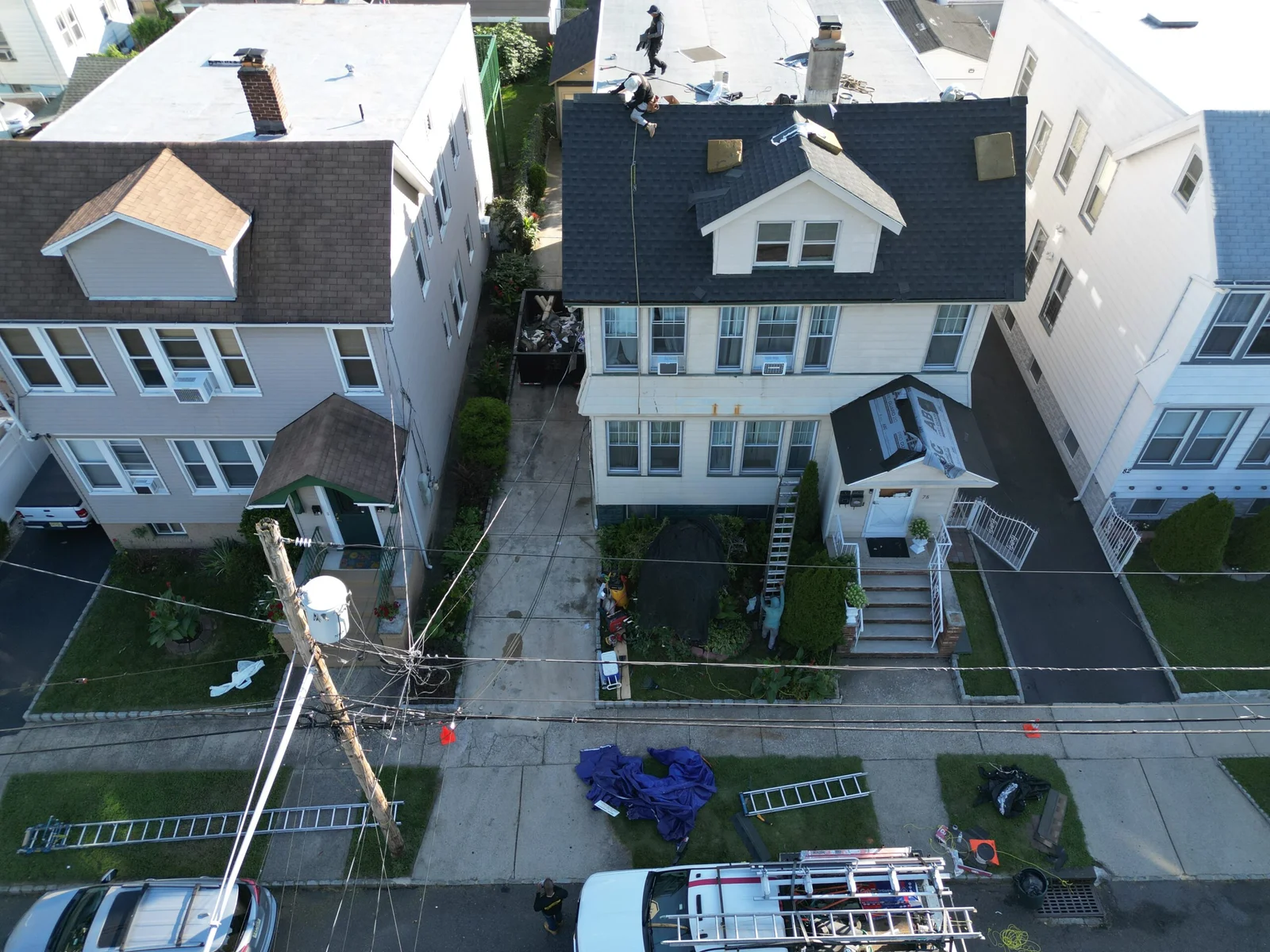
The clearest way to think about this: material costs and labor rates at a legitimate contractor are largely fixed by market conditions. Scope, timing, and bundled work are where the real flexibility lives.
The practical implication: the most effective way to reduce what you pay is not to ask the contractor to cut their margin, it is to structure the project differently. Timing it for a slower period, bundling it with adjacent work, or adjusting the scope in ways that do not compromise the core installation quality are all legitimate levers that benefit both sides.
New Jersey has a real seasonal demand pattern for roofing, and that pattern creates genuine pricing opportunity for homeowners who are not in an emergency situation.
The November through February window is genuine in NJ, not just marketing. Roofing can be completed in temperatures above 40°F, which covers most NJ winter days. The shingle adhesive seals properly once temperatures rise in spring, and the installation itself is sound. Contractors who are scheduling aggressively in the slower months will often offer meaningful price reductions — not because the work is worth less, but because a booked winter crew is more valuable to them than an idle one.
If your roof is not actively leaking and you are planning ahead, calling NJ Roofing in November or December to schedule a January or February installation is the clearest path to pricing flexibility. We can typically offer better pricing for confirmed winter bookings because it keeps our crews productive through a period when many contractors go quiet.
If you need both a roof replacement and gutter work — and in New Jersey those two often go together, since old gutters are typically removed during a full replacement anyway — pricing them as a single project rather than two separate jobs is genuinely cost-effective for both the contractor and the homeowner.
The efficiency gains are real. The crew is already on site. The dumpster is already there. The mobilization cost is shared. A contractor setting up for a gutter job the week after finishing a roof is driving to your property twice, loading and unloading twice, and doing paperwork twice. Bundling eliminates that duplication and the savings can reasonably be passed to the homeowner.
The same logic applies to siding, ventilation upgrades, and skylight work. If any of those are in your near-term plans, the conversation about doing them together at the time of the roof replacement is worth having before the roofing project starts, not after.
Gutter cleaning or replacement, gutter guard installation, attic ventilation upgrades (ridge vent, soffit vents), skylight resealing or replacement, and siding repairs where the roof meets a wall. Any of these done at the same time as a roof replacement saves mobilization cost that a good contractor can share with you.
The most common mistake homeowners make when they receive multiple quotes is comparing total price without comparing scope. A $13,000 quote and a $10,500 quote for the same house are not comparable if one specifies GAF Timberline HDZ with full ice and water shield and synthetic underlayment, and the other specifies a standard 3-tab shingle with felt underlayment and no drip edge. Those are different products delivering different results and different warranty coverage. The $2,500 difference in upfront cost is real. The gap in 10-year outcome is larger.
Both quotes should name the specific shingle: not "architectural shingle" but "GAF Timberline HDZ" or "Owens Corning Duration." Standard and premium architectural shingles within the same brand can differ by $800 to $1,500 on an average NJ home. If the quotes use different products, they are not comparable until you equalize the materials.
NJ building code requires ice and water shield at the eaves. A quote that specifies felt underlayment (15-lb or 30-lb) versus synthetic underlayment is a meaningful difference in both material quality and labor installation time. Verify what each quote includes explicitly.
A quote that does not include a permit is effectively quoting a different product: an unpermitted roof. Ask each contractor explicitly whether the permit is included in the price and who pulls it. The answer matters for your insurance coverage, your resale position, and your legal standing if workmanship issues arise later.
A contractor offering a 10-year workmanship warranty is offering something fundamentally different from a contractor offering a GAF Golden Pledge. The manufacturer warranty is backed by GAF Corporation; the workmanship warranty is backed by whether that contractor is still in business and willing to honor it in year seven. These are not equivalent. See our warranty guide for the full breakdown.
Verify both contractors' NJ HIC license numbers at njconsumeraffairs.gov. Ask for current certificates of general liability and workers' compensation insurance from each. A contractor without workers' comp creates personal liability for you if a crew member is injured on your property. This is not a technicality — it is a real exposure. NJ Roofing's license is #13VH09260500.
If one quote is 25 percent or more below the others for an apparently equivalent scope, the most likely explanations are: no permit is being pulled, the crew is not insured, the material specified has been quietly downgraded, or the contractor will not be reachable after the check clears. A legitimate contractor cannot consistently work 25 percent below a well-run competitor and maintain the overhead that makes them accountable. The money has to come from somewhere.
There is a version of this conversation that is productive, and a version that is not. The unproductive version is asking a contractor to match a lower price without any additional context. The productive version creates an actual opportunity for adjustment.
NJ Roofing provides itemized written estimates with material specs, not lump sums. If you have a competing quote, we will walk through it with you line by line. No pressure, no gimmicks.
This is the honest version of our pricing position, because the original article on this topic deserves a straight answer rather than a generic "we'll work with you."
What we will do: Walk through our estimate with you line by line, explain every cost component, adjust the scope if a legitimate adjustment is possible (timing, bundling, shingle tier), and show you current specials or financing options that might reduce the net cost without reducing the quality of the installation.
What we will not do: Reduce our quote by eliminating the permit, downgrading materials to an unspecified tier to hit a target number, using an uninsured crew to cut labor cost, or matching a quote from an unlicensed contractor. Those adjustments reduce the price and transfer the risk to you in ways that are not in your interest even if the number looks better in the short term.
The most useful thing we can do when a homeowner receives a lower competing quote is look at it together. In our experience, most significant quote gaps come from one of the issues in the comparison checklist above — different shingle tier, missing permit, different warranty terms, or different insurance status. When those differences are identified, the comparison becomes clear and the decision becomes straightforward.
NJ Roofing provides itemized written estimates with no lump sums and no pressure. Licensed #13VH09260500. $2M+ insured. GAF Master Elite certified. Serving NJ since 2016.
