For most single-family and two-family homes in New Jersey, no permit is required to replace your roof. As of March 5, 2018, the NJ Department of Community Affairs classifies standard residential roof replacement as "ordinary maintenance," which is exempt from the construction permit requirement. Commercial buildings, multi-family properties with 3+ units, and structural changes always require a permit. Read on for the exact rules that apply to your situation.
Before 2018, many homeowners and contractors assumed a permit was always needed for roof work in New Jersey. That changed on March 5, 2018, when the New Jersey Department of Community Affairs issued a formal clarification: for single-family and two-family dwellings, replacing or repairing a roof covering is classified as "ordinary maintenance" under the New Jersey Uniform Construction Code.
Ordinary maintenance is specifically exempt from the construction permit requirement. This means a licensed roofer can tear off your old shingles, install new underlayment, and replace the entire roof covering on a qualifying residential property without pulling a permit, as long as the work does not alter the structure underneath.
The DCA exemption covers the roof covering: shingles, tiles, membrane, underlayment, and flashings. It does not cover changes to rafters, trusses, large-scale decking replacement due to structural rot, or alterations to the roof pitch or shape.
The following types of roofing work on a single-family or two-family home in New Jersey generally do not require a construction permit:
The vast majority of standard residential roof replacements in New Jersey fall into this no-permit category. A properly licensed contractor can complete the entire project without permit delay or municipal inspection scheduling.
There are specific situations where a permit is always required, regardless of property type:
If you are converting a two-family home to three or more units, any associated roof work requires a permit even if the roof replacement itself would otherwise qualify as ordinary maintenance under DCA rules.
Use this table as a quick reference. For any situation that falls in a grey area, confirm with your local NJ municipal building department before starting work.
| Property Type | Type of Work | Permit Required? |
|---|---|---|
| Single-family home | Full shingle replacement, no structural changes | No Permit |
| Two-family home | Full shingle or membrane replacement, no structural changes | No Permit |
| Single-family home | Changing roof pitch or adding dormers | Permit Required |
| Single-family home | Structural deck replacement due to rot or damage | Permit Required |
| Apartment building (3+ units) | Any roof replacement or repair | Permit Required |
| Commercial building | Any roof replacement or repair | Permit Required |
| Any property | Solar panel or rooftop HVAC installation | Permit Required |
| Any property | Emergency tarp after storm damage | No Permit |
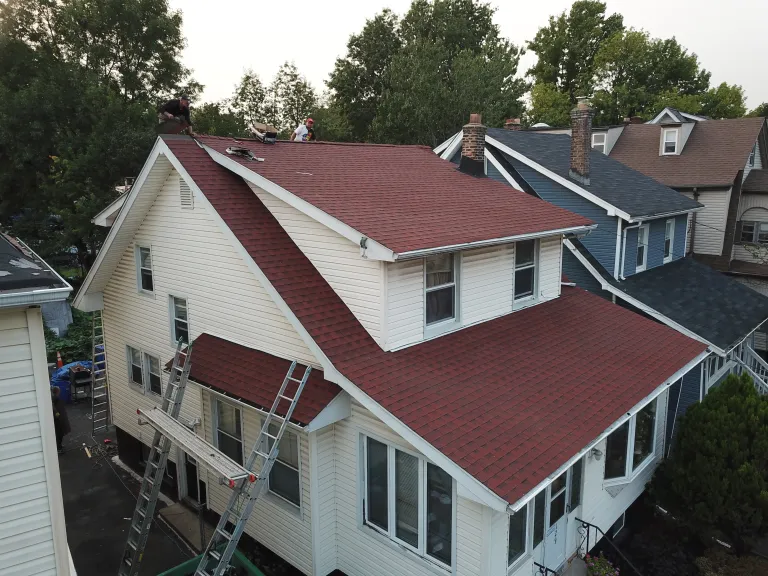
A permit exemption does not mean the work can be done to any standard. Even when no permit is required, all roofing work in New Jersey must comply with the New Jersey Uniform Construction Code (UCC).
The UCC establishes minimum standards for materials, installation methods, wind uplift resistance, and fire ratings. In practical terms, this means:
Hiring a licensed NJ roofing contractor is the most reliable way to ensure UCC compliance on permit-exempt work. An unlicensed crew may not know or follow these standards, leaving you with a non-compliant installation that can create problems when you sell the home or file an insurance claim.
The DCA's 2018 classification is a statewide rule, but New Jersey's 565 municipalities have significant latitude to layer additional requirements on top of state minimums. Some towns have specific roofing ordinances that go beyond DCA guidance, including:
Before beginning any roofing project in New Jersey, call your local municipal building department to confirm whether any additional local requirements apply beyond the DCA statewide guidance. This single step can prevent fines, stop-work orders, and title complications at the time of sale.
NJ Roofing is GAF Master Elite certified and handles all permit and non-permit roofing work throughout New Jersey. Get a free written estimate with no obligation.
